Spiders (order Araneae) are air-breathing arthropods that have eight legs and chelicerae with fangs that inject venom. They are the largest order of arachnids and rank seventh in total species diversity among all other groups of organisms. Spiders are found worldwide on every continent except for Antarctica, and have become established in nearly every habitat with the exception of air and sea colonization. As of 2008, at least 43,678 spider species, and 109 families have been recorded by taxonomists; however, there has been confusion within the scientific community as to how all these families should be classified, as evidenced by the over 20 different classifications that have been proposed since 1900
Anatomically, spiders differ from other arthropods in that the usual body segments are fused into two tagmata, the cephalothorax and abdomen, and joined by a small, cylindrical pedicel. Unlike insects, spiders do not have antennae. In all except the most primitive group, the Mesothelae, spiders have the most centralized nervous systems of all arthropods, as all their ganglia are fused into one mass in the cephalothorax. Unlike most arthropods, spiders have no extensor muscles in their limbs and instead extend them by hydraulic pressure.
Their abdomens bear appendages that have been modified into spinnerets that extrude silk from up to six types of silk glands within their abdomen. Spider webs vary widely in size, shape and the amount of sticky thread used. It now appears that the spiral orb web may be one of the earliest forms, and spiders that produce tangled cobwebs are more abundant and diverse than orb-web spiders. Spider-like arachnids with silk-producing spigots appeared in the Devonian period about 386 million years ago, but these animals apparently lacked spinnerets. True spiders have been found in Carboniferous rocks from 318 to 299 million years ago, and are very similar to the most primitive surviving order, the Mesothelae. The main groups of modern spiders, Mygalomorphae and Araneomorphae, first appeared in the Triassic period, before 200 million years ago.
A herbivorous species, Bagheera kiplingi, was described in 2008, but all other known species are predators, mostly preying on insects and on other spiders, although a few large species also take birds and lizards. Spiders use a wide range of strategies to capture prey: trapping it in sticky webs, lassoing it with sticky bolas, mimicking the prey to avoid detection, or running it down. Most detect prey mainly by sensing vibrations, but the active hunters have acute vision, and hunters of the genus Portia show signs of intelligence in their choice of tactics and ability to develop new ones. Spiders' guts are too narrow to take solids, and they liquidize their food by flooding it with digestive enzymes and grinding it with the bases of their pedipalps, as they do not have true jaws.
Male spiders identify themselves by a variety of complex courtship rituals to avoid being eaten by the females. Males of most species survive a few matings, limited mainly by their short life spans. Females weave silk egg-cases, each of which may contain hundreds of eggs. Females of many species care for their young, for example by carrying them around or by sharing food with them. A minority of species are social, building communal webs that may house anywhere from a few to 50,000 individuals. Social behavior ranges from precarious toleration, as in the widow spiders, to co-operative hunting and food-sharing. Although most spiders live for at most two years, tarantulas and other mygalomorph spiders can live up to 25 years in captivity.
While the venom of a few species is dangerous to humans, scientists are now researching the use of spider venom in medicine and as non-polluting pesticides. Spider silk provides a combination of lightness, strength and elasticity that is superior to that of synthetic materials, and spider silk genes have been inserted into mammals and plants to see if these can be used as silk factories. As a result of their wide range of behaviors, spiders have become common symbols in art and mythology symbolizing various combinations of patience, cruelty and creative powers.
Bats are mammals of the order Chiroptera (/kaɪˈrɒptərə/; from the Greek χείρ - cheir, "hand" and πτερόν - pteron, "wing") whose forelimbs form webbed wings, making them the only mammals naturally capable of true and sustained flight. By contrast, other mammals said to fly, such as flying squirrels, gliding possums, and colugos, can only glide for short distances. Bats do not flap their entire forelimbs, as birds do, but instead flap their spread-out digits, which are very long and covered with a thin membrane or patagium.
Bats represent about 20% of all classified mammal species worldwide, with about 1,240 bat species divided into two suborders: the less specialized and largely fruit-eating megabats, or flying foxes, and the more highly specialized and echolocating microbats.About 70% of bats are insectivores. Most of the rest are frugivores, or fruit eaters. A few species, such as the fish-eating bat, feed from animals other than insects, with the vampire bats being hematophagous.
Bats are present throughout most of the world, performing vital ecological roles of pollinating flowers and dispersing fruit seeds. Many tropical plant species depend entirely on bats for the distribution of their seeds. Bats are important in eating insect pests, reducing the need for pesticides. The smallest bat is the Kitti's hog-nosed bat, measuring 29–34 mm (1.14–1.34 in) in length, 15 cm (5.91 in) across the wings and 2–2.6 g (0.07–0.09 oz) in mass. It is also arguably the smallest extant species of mammal, with the Etruscan shrew being the other contender. The largest species of bat are a few species of Pteropus and the giant golden-crowned flying fox with a weight up to 1.6 kg (4 lb) and wingspan up to 1.7 m
The giraffe (Giraffa camelopardalis) is an African even-toed ungulate mammal, the tallest living terrestrial animal and the largest ruminant. Its species name refers to its camel-like appearance and the patches of color on its fur. Its chief distinguishing characteristics are its extremely long neck and legs, its horn-like ossicones and its distinctive coat patterns. It stands 5–6 m (16–20 ft) tall and has an average weight of 1,600 kg (3,500 lb) for males and 830 kg (1,800 lb) for females. It is classified under the family Giraffidae, along with its closest extant relative, the okapi. The nine subspecies are distinguished by their coat patterns.
The giraffe's scattered range extends from Chad in the north to South Africa in the south, and from Niger in the west to Somalia in the east. Giraffes usually inhabit savannas, grasslands, and open woodlands. Their primary food source is acacia leaves, which they browse at heights most other herbivores cannot reach. Giraffes are preyed on by lions, and calves are also targeted by leopards, spotted hyenas and wild dogs. Adult giraffes do not have strong social bonds, though they do gather in loose aggregations if they happen to be moving in the same general direction. Males establish social hierarchies through "necking", which are combat bouts where the neck is used as a weapon. Dominant males gain mating access to females, which bear the sole responsibility for raising the young.
The giraffe has intrigued various cultures, both ancient and modern, for its peculiar appearance, and has often been featured in paintings, books and cartoons. It is classified by the International Union for Conservation of Nature as Least Concern, but has been extirpated from many parts of its former range, and some subspecies are classified as Endangered. Nevertheless, giraffes are still found in numerous national parks and game reserves.
Whale (origin Old English hwæl from Proto-Germanic *hwalaz) is the common name for various marine mammals of the order Cetacea. The term whale sometimes refers to all cetaceans, but more often it excludes dolphins and porpoises, which belong to the suborder Odontoceti (toothed whales). This suborder also includes the sperm whale, killer whale, pilot whale, and beluga whale. The other Cetacean suborder, Mysticeti (baleen whales), comprises filter feeders that eat small organisms caught by straining seawater through a comblike structure found in the mouth called baleen. This suborder includes the blue whale, the humpback whale, the bowhead whale and the minke whale. All cetaceans have forelimbs modified as fins, a tail with horizontal flukes, and nasal openings (blowholes) on top of the head.
Whales range in size from the blue whale, the largest animal known to have ever existed at 30 m (98 ft) and 180 tonnes (180 long tons; 200 short tons), to various pygmy species, such as the pygmy sperm whale at 3.5 m (11 ft). Whales collectively inhabit all the world's oceans and number in the millions, with annual population growth rate estimates for various species ranging from 3% to 13%
Sharks are a group of fish characterized by a cartilaginous skeleton, five to seven gill slits on the sides of the head, and pectoral fins that are not fused to the head. Modern sharks are classified within the clade Selachimorpha (or Selachii), and are the sister group to the rays. However, the term "shark" has also been used for extinct members of the subclass Elasmobranchii outside the Selachimorpha, such as Cladoselache and Xenacanthus. Under this broader definition, the earliest known sharks date from more than 420 million years ago.
Since, sharks have diversified into over 470 species. They range in size from the small dwarf lanternshark (Etmopterus perryi), a deep sea species of only 17 centimetres (6.7 in) in length, to the whale shark (Rhincodon typus), the largest fish in the world, which reaches approximately 12 metres (39 ft). Sharks are found in all seas and are common to depths of 2,000 metres (6,600 ft). They generally do not live in freshwater although there are a few known exceptions, such as the bull shark and the river shark, which can survive in both seawater and freshwater. They breathe through five to seven gill slits. Sharks have a covering of dermal denticles that protects their skin from damage and parasites in addition to improving their fluid dynamics. They have several sets of replaceable teeth.
Well-known species such as the great white shark, tiger shark, blue shark, mako shark, and the hammerhead shark are apex predators—organisms at the top of their underwater food chain. Their survival is threatened by human-related activities.
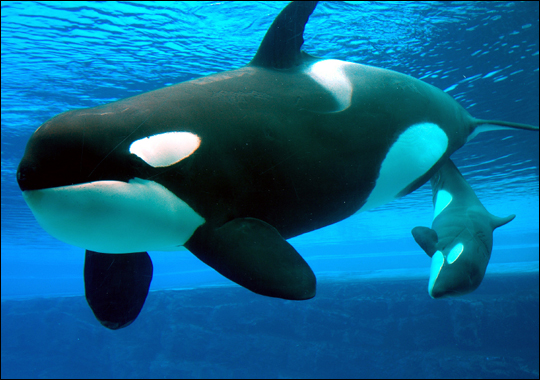
Dolphins are marine mammals closely related to whales and porpoises. There are almost forty species of dolphin in 17 genera. They vary in size from 1.2 m (4 ft) and 40 kg (90 lb) (Maui's dolphin), up to 9.5 m (30 ft) and 10 tonnes (9.8 long tons; 11 short tons) (the orca or killer whale). They are found worldwide, mostly in the shallower seas of the continental shelves, and are carnivores, eating mostly fish and squid. The family Delphinidae is the largest in the Cetacean order, and evolved relatively recently, about ten million years ago, during the Miocene. Dolphins are among the most intelligent animals, and their often friendly appearance, an artifact of the "smile" of their mouthline, and seemingly playful attitude have made them very popular in human culture.
Snakes are elongated, legless, carnivorous reptiles of the suborder Serpentes that can be distinguished from legless lizards by their lack of eyelids and external ears. Like all squamates, snakes are ectothermic, amniote vertebrates covered in overlapping scales. Many species of snakes have skulls with many more joints than their lizard ancestors, enabling them to swallow prey much larger than their heads with their highly mobile jaws. To accommodate their narrow bodies, snakes' paired organs (such as kidneys) appear one in front of the other instead of side by side, and most have only one functional lung. Some species retain a pelvic girdle with a pair of vestigial claws on either side of the cloaca.
Living snakes are found on every continent except Antarctica, in the Pacific and Indian Oceans, and on most smaller land masses — exceptions include some large islands, such as Ireland and New Zealand, and many small islands of the Atlantic and central Pacific. More than 20 families are currently recognized, comprising about 500 genera and about 3,400 species. They range in size from the tiny, 10 cm-long thread snake to the Reticulated python of up to 8.7 meters (29 ft) in length. The fossil species Titanoboa cerrejonensis was 15 meters (49 ft) long. Snakes are thought to have evolved from either burrowing or aquatic lizards during the mid-Cretaceous period, and the earliest known fossils date to around 112 Ma ago. The diversity of modern snakes appeared during the Paleocene period (c 66 to 56 Ma ago). The oldest preserved descriptions of snakes can be found in the Brooklyn Papyrus.
Most species are nonvenomous and those that have venom use it primarily to kill and subdue prey rather than for self-defense. Some possess venom potent enough to cause painful injury or death to humans. Nonvenomous snakes either swallow prey alive or kill by constriction.
The kangaroo /ˌkæŋɡəˈruː/ is a marsupial from the family Macropodidae (macropods, meaning 'large foot'). In common use the term is used to describe the largest species from this family, especially those of the genus Macropus, red kangaroo, antilopine kangaroo, eastern grey kangaroo and western grey kangaroo. Kangaroos are endemic to Australia. The smaller macropods are found in Australia and New Guinea.
Kangaroos have large, powerful hind legs, large feet adapted for leaping, a long muscular tail for balance, and a small head. Like most marsupials, female kangaroos have a pouch called a marsupium in which joeys complete postnatal development.
Larger kangaroos have adapted much better[which?] to changes brought to the Australian landscape by humans and though many of their smaller cousins are endangered, they are plentiful. They are not farmed to any extent, but wild kangaroos are shot for meat, leather hides, and to protect grazing land for sheep and cattle. Although there is some controversy, harvesting kangaroo meat has many environmental and health benefits over traditional meats.
The kangaroo is an unofficial symbol of Australia, and appears as an emblem on the Australian coat of arms, on some of its currency, and is used by some of Australia's well known organisations, including Qantas and the Royal Australian Air Force. The kangaroo is important to both Australian culture and the national image, and consequently there are numerous popular culture references.
Zebras are several species of African equids (horse family) united by their distinctive black and white stripes. Their stripes come in different patterns, unique to each individual. They are generally social animals that live in small harems to large herds. Unlike their closest relatives, horses and asses, zebras have never been truly domesticated.
There are three species of zebras: the plains zebra, the Grévy's zebra and the mountain zebra. The plains zebra and the mountain zebra belong to the subgenus Hippotigris, but Grévy's zebra is the sole species of subgenus Dolichohippus. The latter resembles an ass, to which it is closely related, while the former two are more horse-like. All three belong to the genus Equus, along with other living equids.
The unique stripes of zebras make them one of the animals most familiar to people. They occur in a variety of habitats, such as grasslands, savannas, woodlands, thorny scrublands, mountains, and coastal hills. However, various anthropogenic factors have had a severe impact on zebra populations, in particular hunting for skins and habitat destruction. Grévy's zebra and the mountain zebra are endangered. While plains zebras are much more plentiful, one subspecies, the quagga, became extinct in the late 19th century – though there is currently a plan, called the Quagga Project, that aims to breed zebras that are phenotypically similar to the quagga in a process called breeding back.
Rabbits are small mammals in the family Leporidae of the order Lagomorpha, found in several parts of the world. There are eight different genera in the family classified as rabbits, including the European rabbit (Oryctolagus cuniculus), cottontail rabbits (genus Sylvilagus; 13 species), and the Amami rabbit (Pentalagus furnessi, an endangered species on Amami Ōshima, Japan). There are many other species of rabbit, and these, along with pikas and hares, make up the order Lagomorpha. The male is called a buck and the female is a doe; a young rabbit is a kitten or kit.